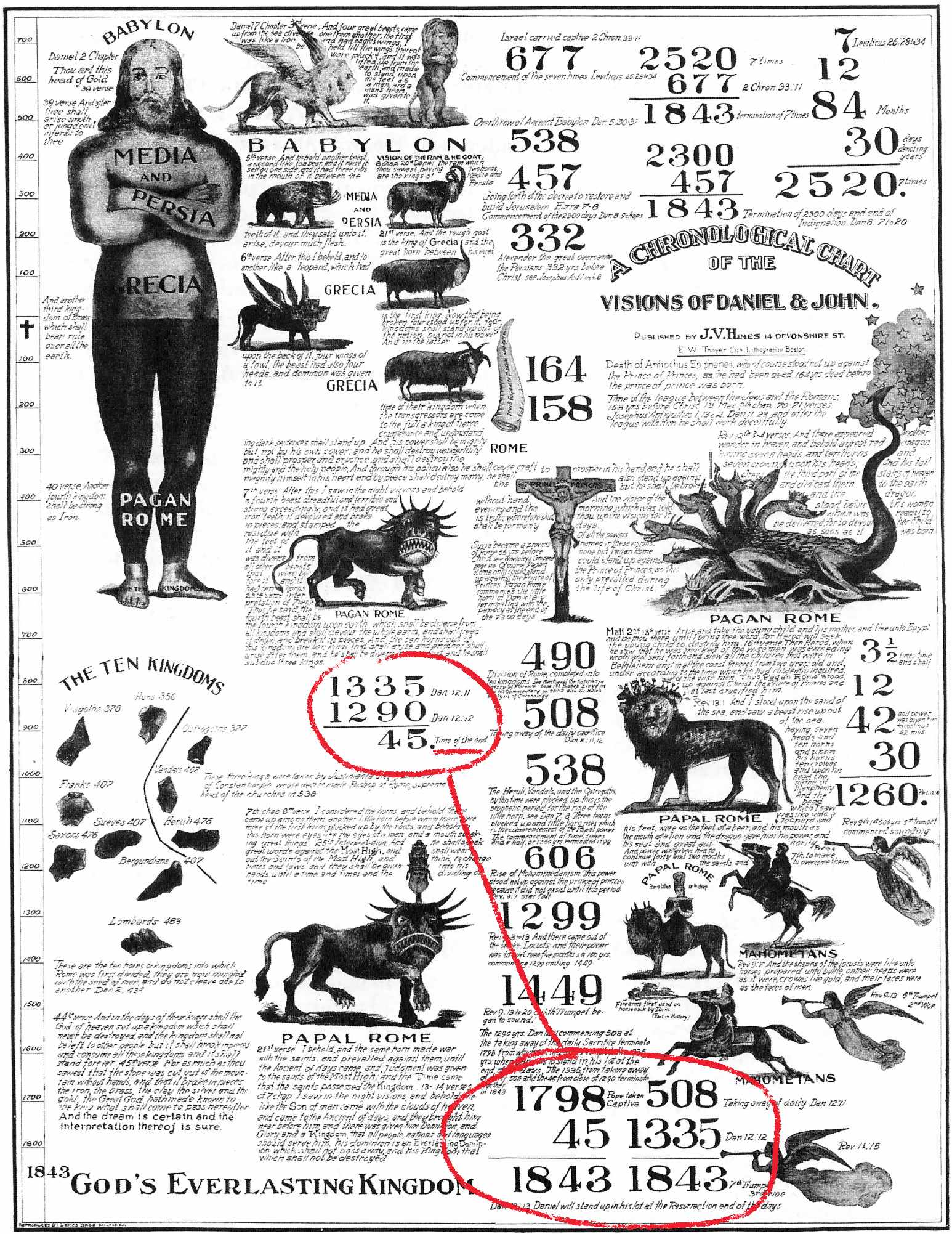
The year 1798 is an important date. It identifies the end of that centuries-long epoch during which the oppressive church of Rome tortured to death millions of thinking dissenters. It is the dividing line between the dark ages of Europe and the dawn of religious freedom and great light.
During the first part of the nineteenth century, in democratic, Protestant America, Baptist preacher, William Miller correctly recognised 1798 as the end of the 1260 years of persecution foretold in Daniel 7:25 and Revelation 13:5. This was not speculation.
On the 15th of February 1798, Napoleon's General Berthier entered Rome, took the pope prisoner, and inflicted on the Vatican what was thought to be a “mortal wound” from which the papal church would never recover. It was William Miller’s 16th birthday.
Prophecy had been unmistakably fulfilled for all the world to see.
1798 is an immovable and uncontested milestone in human history.
From their study of the prophecies Miller and his associates
expected Christ to return in 1843 — and logically that would mean the “the end”.
They concluded that the 45 years between 1798 and 1843 corresponded to the final 45 ‘days’ between the 1290 and 1335 ‘days’ of Daniel’s prophecy. So they confidently labelled it, the “Time of the End”.
They produced a complex visual
chart showing prophetic symbols and timelines.
Assuming all prophetic “days” represented years, they naturally concluded the “1335 years” must end with Christ’s return—in 1843. So simple arithmetic required the time to start in 508 AD (1843 – 1335 = 508).
In 1842 this interpretation seemed convincing.
But Christ did not return. Their assumptions —
about The End of Time — were demonstrated to be incorrect. Unequivocally so.
William Miller got something right about Daniel’s last prophecy, however. He recognised the 1335 days terminated at the very end of Earth’s history. The prophecy itself requires that. It’s not negotiable.
Where he went off the rails is that Miller assumed Jesus would come at the end of the 2300 days of 8:14. And therefore the 1335 days must also terminate there. That’s incongruent conflation.
Jesus didn’t come.
The world didn’t end.
Which means the end of the 1335 days was incorrectly placed. Anachronistic. Both logic and history disallow any other conclusion. And it also means that the whole of Daniel’s last prophecy must necessarily still be future. None of it can properly be said to have been already fulfilled.
Not without resorting to Preterism or Futurism—or both. Which requires tearing the prophecy apart.
By now, in early Adventist circles, the expression “the Time of the End” had become linked to the Millerite understanding.
Almost two centuries later Christ has still not returned. William Miller’s understanding of the“Time of the End” was clearly not the same as Jesus’. Daniel 11:40–12:13 describes events that belong exclusively to the closing period of Earth’s history—the very time Jesus pointed to in response to the disciples’ “end-of-the-world question” (Matthew 24:15).
Obviously that still lies ahead of us.
Consider: Would God give us a prophecy, specifically intended for the end of time, if every one of its time components have already been fulfilled—beginning more than 1,500 years ago and ending almost two centuries in our past?
Ellen White consistently identified 1798 as the
beginning of the Time of the End, never 508. She described it as the commencement of a period of unspecified length “that extends to the very eve of the consummation”, never as an interval ending in 1843.
In fact, she and husband James wrestled unsuccessfully with the enigma of the 1335 days and produced a completely revised chart which was printed by Otis Nichols in
1850. This new chart omitted all reference to the 1335 days because “God had shown her there was an error” in Miller’s understanding of of them.
Over time, the phrase the "Time of the End" has become familiar Adventist terminology. But in the process it has drifted far away from the meaning Daniel gave it. In fact the outcome has been a dangerously misleading, unbiblical tradition that has diverted attention away from Jesus’ warning.
Of the greatest significance to us is the fact that Daniel 12 contains the
only sign Jesus pointedly warned His followers to recognise. Yet that sign is completely buried by the unfounded assumptions inherited from the Millerite phenomenon—presumptions that history itself has shown to be mistaken.
(Note: we refer here to the last prophecy in Daniel’s book, which commences at chapter 11:40. We are not commenting on the validity of the 2,300 days prophecy of 8:14.)Since we now know those assumptions were
mistaken honesty requires Daniel's final prophecy to be re-examined with fresh eyes.
In truth the implications could not be more important. In
70 AD it was crucial.
Failing to decouple William Miller’s honest error from Daniel’s final prophecy has produced much confusion.
For us it has now literally become a fast-looming matter of life and death.
“Let him who reads understand.”
••••••••••••••••The Möbius loop is a famous optical illusion that aptly illustrates the logical and historical implausibility of the common understanding of the 1335 Days prophecy in Daniel 12.